
For centuries, readers have been captivated by the sharp wit and social commentary found in the novels of Jane Austen. From the romantic tensions of Pride and Prejudice to the moral complexities of Sense and Sensibility, her work remains a cornerstone of English literature. However, behind these polished masterpieces lay a chaotic domestic life and a writing process defined by secrecy rather than solitude. After a period of instability following her father’s death, Austen finally found her stride in 1809 upon moving into a cottage in Chawton provided by her brother.
Life at Chawton was far from quiet, yet Austen managed to carve out a rigorous daily schedule that balanced familial duty with artistic ambition. An early riser, she typically began her mornings playing the piano or handling correspondence before organizing the family breakfast at nine o’clock. While many women of her era were bogged down by endless chores, Austen focused primarily on breakfast preparations, leaving the heavier burdens of housework to her sister Cassandra. This arrangement was vital for her creativity; Austen famously noted that composing literature was nearly impossible when one’s mind was preoccupied with joints of mutton or medicinal rhubarb.
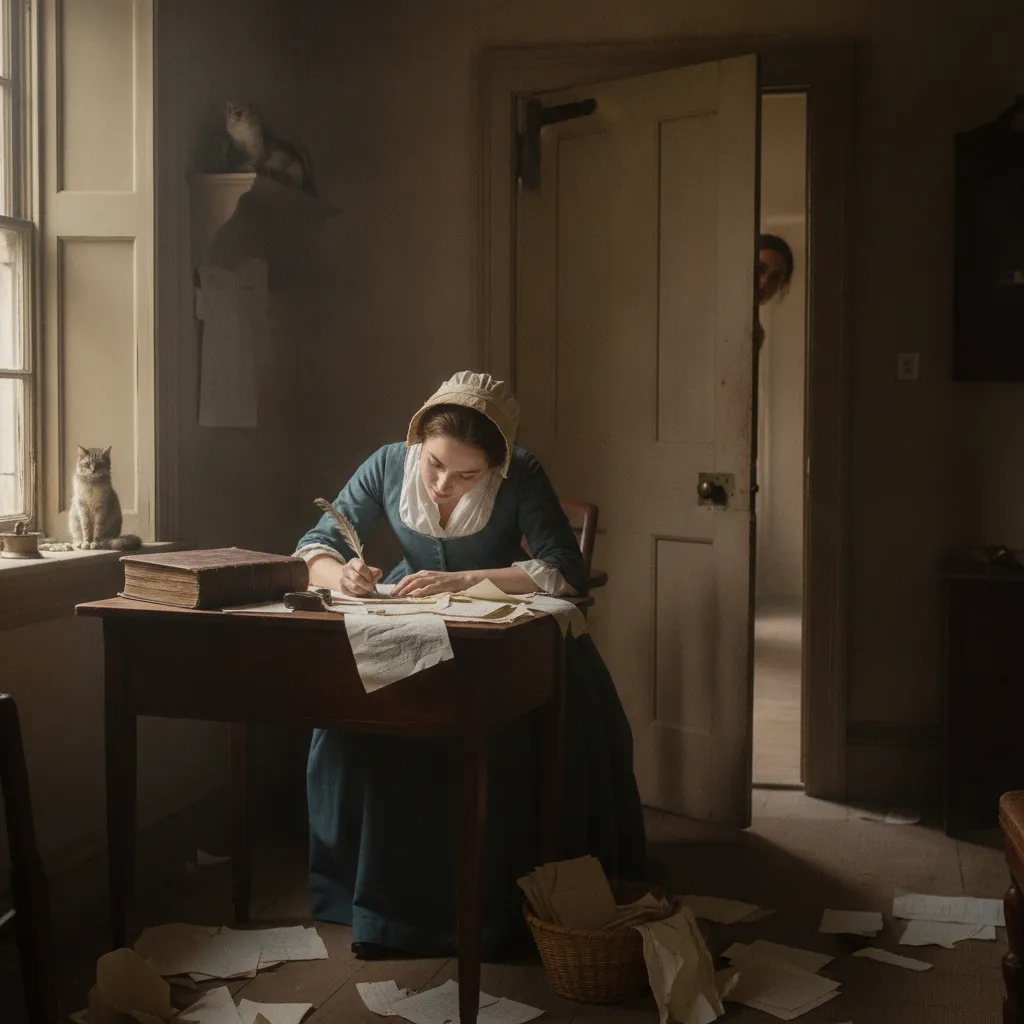
Perhaps most surprising is that some of history’s greatest literary scenes were written in plain sight within a busy shared sitting room. Rather than retreating to a private study, Austen wrote while her mother and sister sewed beside her, frequently dealing with the intrusion of unannounced guests. To protect her privacy in such an open environment, she employed several clever tactics. She insisted that the servants leave the sitting room door un-oiled so its loud creak would warn her of an arrival, giving her just enough time to conceal her manuscripts. By using small slips of paper instead of large notebooks, she ensured that her latest chapters could be tucked away in an instant whenever company arrived.